
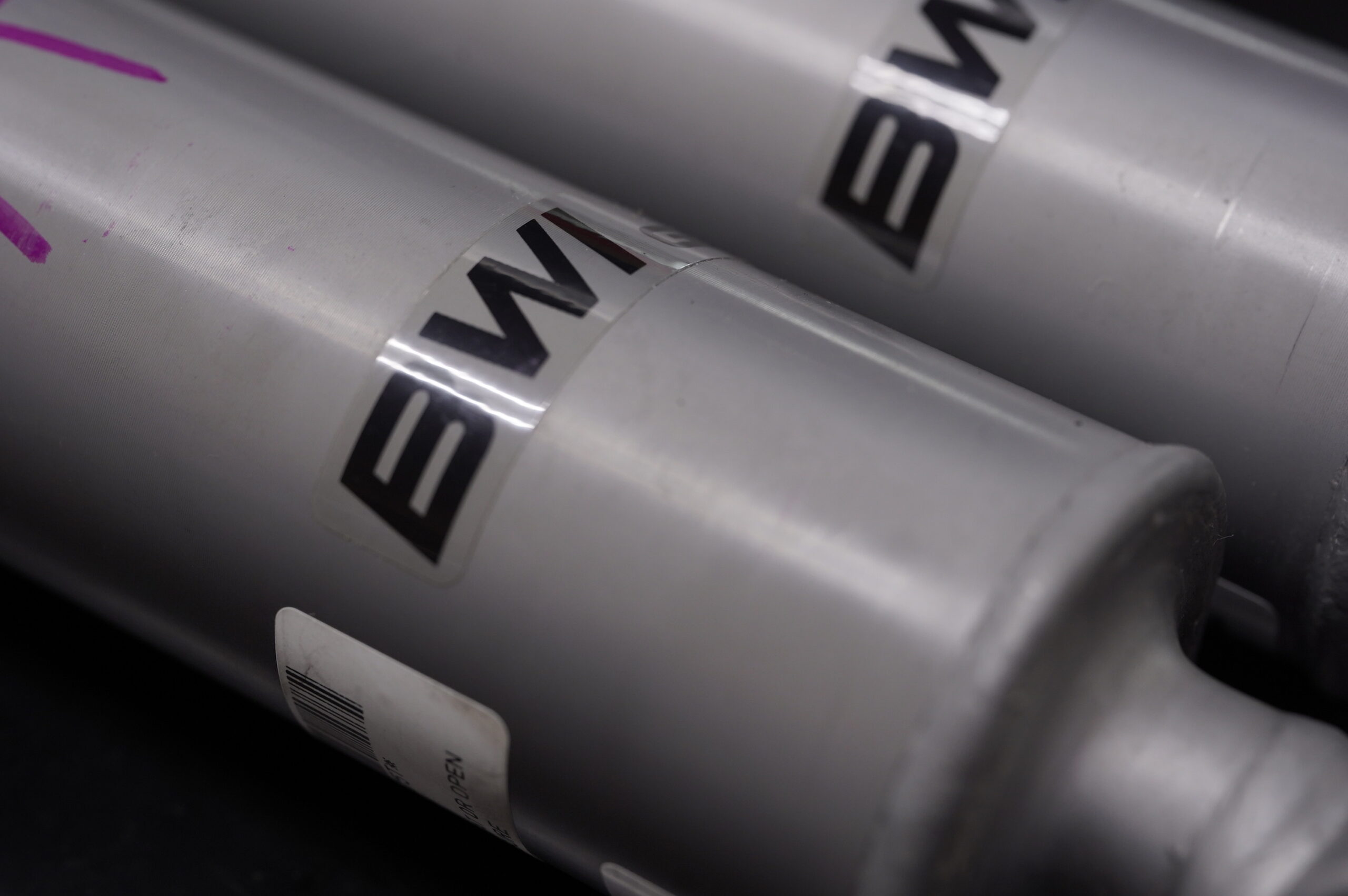
Inside the BWI MagneRide: Breaking Open the “Black Box” of Modern Suspension(79 views)
Subtitle:
A Technical Report from SGF Japan on Why Hardware Simplicity Demands Software Complexity
Prologue: Breaching the Sanctuary
Editor: Mr. Shimbo, today we are diving into a highly niche and complex topic: the BWI Magnetic Ride Dampers (MagneRide) found in supercars like Ferrari and Lamborghini. Generally, these are considered “black boxes”—if they fail, the only option is a complete assembly replacement. Is that correct?
Shimbo (SGF): Exactly. Whether you consult an authorized dealer or a specialist shop, the standard protocol is “Assy Replacement” (replacing the entire unit). The internal structure is treated as a “sanctuary”—something too specialized to touch.
However, that is precisely why it is worth dissecting as SGF. We cannot call ourselves professionals if we handle these vehicles without understanding the “possibility of repair” and the “truth inside.”
Editor: So, you actually acquired a research unit and dismantled it?
Shimbo: Yes. I took it apart completely.
What I found inside was contrary to its high-tech image. It revealed an extremely rationalized—and in a sense, a “cruel”—reality.
Chapter 1: The “Iron Lump” of Extreme Rationalization
Editor: A “cruel reality”? Was the internal structure that complicated?
Shimbo: Quite the opposite. It turned out to be far simpler inside than its high-tech image suggests.
There were no “shims” (leaf springs) or complex “orifices” (oil paths) that you invariably find in traditional high-end dampers.
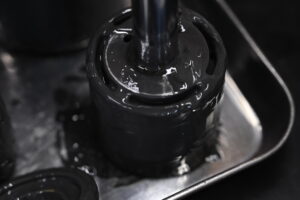
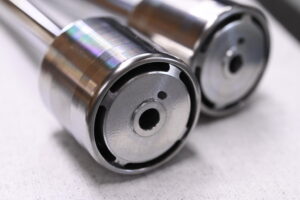
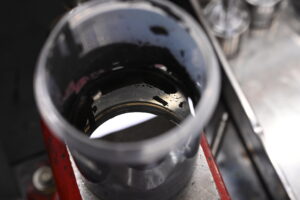
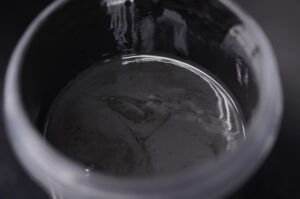
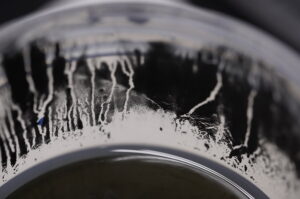
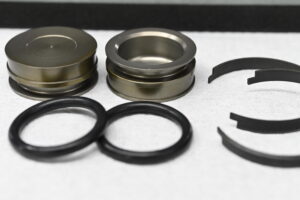
All that emerged was a coil wound with thick copper wire, a magnetic block called a piston, and the viscous magnetic fluid — a magnetorheological (MR) fluid, essentially an oil containing magnetic particles.
Editor: Wait, no shims? Then how does it generate damping force?
Shimbo: That is the core of BWI technology. Instead of using mechanical resistance (deflection of shims), it generates resistance by running an electric current to alter the viscosity of the MR fluid itself.
Therefore, the hardware structure has been “functionally purified.”
As you can see in the photos, the piston is effectively just an electromagnet.
Editor: I see… So, does “simple” mean “better”?
Shimbo: “Simple means fast response time” is the correct interpretation. Since there are no mechanical moving parts like shims, there is virtually zero lag.
However, simplicity does not imply “cheapness.”
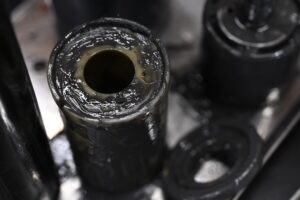
When I inspected the inside of the disassembled cylinder, I was astonished. Despite moving fluid containing iron powder at high speeds, there was extremely minimal wear.
This is proof that substantial costs were invested in the invisible parts—specifically, the tribology (friction control) and coating technologies.
Chapter 2: Is Overhaul Possible?
Editor: If the structure is simple, does that mean we can perform an “Overhaul” (repair), which is the biggest concern for users? New units for a Lamborghini can cost an exorbitant amount…
Shimbo: The conclusion is: “Partially, yes. It is possible even now.”
First, the most common issue is “Fluid Leakage.” While the structure is unique, the sealing logic remains the same as standard dampers. By selecting the appropriate high-grade seal materials and refilling with the correct MR fluid, physical leaks can be resolved.
Editor: That is great news!
Shimbo: Next is “Electrical Trouble.”
If the issue is external, such as a severed wire or a faulty connector, it can be diagnosed and fixed with a tester. This is not a black box either.
Editor: What if the core coil burns out?
Shimbo: That is our current challenge.
We have disassembled the unit and gathered data on coil gauge and resistance values. I have analyzed it with our electronics team, and it is a sound design for an actuator. Physically rewinding it is possible.
However, the process of rewinding inside the piston and re-sealing it is still in the experimental stage at our lab in Japan. Once we establish this protocol, BWI dampers will evolve from “disposable components” to “renewable assets.”
Chapter 3: Hardware Subservience and Software Dominance
Editor: I see… I didn’t realize SGF had dug this deep.
But listening to you, Mr. Shimbo, I’m starting to feel that the “object itself” is surprisingly simple and could potentially be replicated.
Shimbo: You have a sharp intuition.
To be blunt, replicating the hardware (piston and coil) would not be difficult if one had the right equipment.
But that is exactly when you realize the truth:
“The difficulty of technology has shifted from Mechanism to Logic (Control).”
Editor: What do you mean?
Shimbo: Traditional dampers had the correct answer (damping characteristics) physically built into the stack of shims. They were “autonomous machines” that did a good job even without electricity.
In contrast, a BWI unit is just a lump of iron without electricity.
“What viscosity is needed right now?”
“How should the posture change in 0.01 seconds?”
Everything must be constantly managed by “Algorithms and Commands (Software).”
Editor: Ah… So as the hardware becomes simpler, the software driving it must become more intelligent.
Shimbo: Precisely.
The disassembled lump of iron quietly told the story of how modern car manufacturing has irreversibly shifted from “Mechanical-led” to “Software-led.”
Inquiries & Contact Information
Important Notice for International Readers:
The primary purpose of this article is to share technical insight into BWI MagneRide dampers with engineers and suspension specialists around the world, rather than to solicit overseas repair work.
At this time, SGF Japan does not accept overhaul or repair commissions from outside Japan for BWI dampers.
Please treat this report as a technical reference rather than a service invitation if you are located outside Japan.

[For Domestic (Japan) Inquiries Only]
SGF Japan provides technical consultation and repair services exclusively for the Japanese domestic market.
Because handling these components requires a deep understanding of vehicle control systems, we limit our services to B2B partnerships (Automotive Repair Shops, Dealerships, and Specialists).
-
Issues with discontinued stock or prohibitive replacement costs.
-
Diagnostic separation of electronic vs. mechanical failures.
-
Feasibility studies for functional recovery via Overhaul.
Note to Individual Owners:
We do not accept direct requests from individual owners. Please contact us via the workshop or dealer who services your vehicle.
[Contact Information for Domestic B2B Partners]
-
Phone (Dealers Only): 090-3316-5306
-
Email: sgf@sgfacendo.com
-
Web Form: https://sgfacendo.com/contact/
