The Philosophy of Control: Where Software Ends and Physics Takes Over
The Philosophy of Control: Two Questions on Electronics vs. Physics
(Subtitle: Where Software Ends and Suspension Begins)
Thinking About Electronic Control: Two Fundamental Questions
When I think about electronic control, I frame it around two questions: What can software stabilize—and what must physics earn?
We often use analogies like “Active Noise Cancellation.” The goal is to eliminate disturbances and improve the quality of the ride, much like creating a controlled acoustic environment (like a recording studio) where unwanted noise is filtered out.
The conclusion is simple: electronic control is a tool designed to extract the machine’s current performance potential, consistently, anywhere, and by anyone. It is software meant to enhance repeatability. It doesn’t change the underlying physics of the machine; it helps you access its current potential more consistently.
Suspension and chassis design belong to the realm of physics, which forms the foundation. Our job in this physical realm is to gradually expand the usable traction envelope and widen the zone where a rider can throttle on with confidence.
If electronic control helps riders access the machine’s current potential more consistently, then the role of suspension tuning is to expand that usable window and raise the practical performance ceiling.
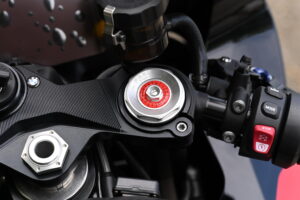
From “Reactive” to “Predictive” Control
A brief look at the history of electronic control shows it started as reactive (feedback control). Early ABS and traction control systems were essentially mechanisms to “stop the slide after it happened.” Because they intervened after the vehicle behavior became unstable, the effect felt somewhat abrupt. Riders often felt, “It saved me, but it felt unnatural.”
With the introduction of the six-axis IMU, the trend has shifted toward predictive (anticipatory control). By monitoring roll, pitch, yaw, and acceleration at high frequencies, the system adjusts power output and brake pressure milliseconds before a slide begins. To human senses, this feels not just real-time; it can feel as though the bike is managing risk proactively.
Looking ahead, we are likely to see a shift toward visually assisted control integrating cameras and radar. The system will “see” road undulations, gaps, and conditions ahead of a corner, preparing the chassis before it even moves. While this is already practical in the automotive world, motorcycles are expected to follow this path with some time lag.
Gamification of Riding and the “Digital Cliff”
While this progress is remarkable, there is also a quiet aspect of gamification taking place. Slide control, cornering ABS, wheelie control… In the sense that these features open up pro-level techniques to general riders to some extent, they are certainly a blessing. When the controls are working well, the behavior is incredibly smooth, and the “noise” seems to disappear.
However, this “cleanliness” does not necessarily mean there is a physical margin. Electronic controls tidy up the situation right up to the very limit. But the moment you exceed the available traction, a “digital cliff” awaits—an abrupt breakaway with fewer progressive warning cues. The analog warning signs—like the gradual sensation of a slide prompting you to slow down—are becoming thinner. For riders maintaining a certain pace, this can paradoxically become a risk. Unknowingly, the electronic controls may be accumulating a “debt,” and the bill might arrive all at once at the very end.
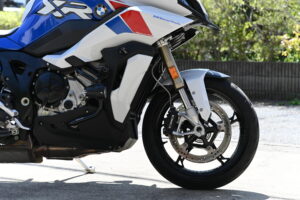
Where Cars and Motorcycles Are Heading
Where are electronic controls heading? Cars are broadly trending toward autonomous driving. The primary focus will likely be removing the human from operation and perfecting the “mobility platform.”
In contrast, motorcycles will likely take a slightly different path. While aiming for a “bike that doesn’t fall,” the joy of control must remain central to the vehicle’s existence. Even as IMUs are joined by cameras and millimeter-wave radar to strengthen the safety net, controlling every unpredictable element on public roads—gravel, oil, sudden obstacles—is still a distant future.
What Electronics Can and Cannot Do
Let’s organize what electronics can and cannot do. Reducing power, modulating brakes, intervening before a slip. These are all subtractive controls. They shave off excessive input and keep the bike within the tire’s available traction. It is a smart system to absorb human error and move you closer to consistent stability across conditions.
However, there are things electronic control simply cannot do. It cannot change the tire–road friction potential. It cannot save a machine that is already physically overspeeding by ignoring the laws of physics. It cannot generate friction on a tire that is not touching the ground. This will always remain outside the defensive range of software.
Suspension: The Hardware Advantage
This is where the suspension (hardware) comes in. A good shock and good springs work to reduce the disturbance itself before the control system has to erase it later. By appropriately managing inputs from the road and keeping the tire more consistently loaded and in contact with the surface, suspension effectively expands the usable traction envelope. It doesn’t create grip out of thin air; it helps you access more of the traction that’s already there by keeping the tire loaded and in its effective operating window.
On a well set-up bike, the frequency of electronic intervention actually decreases. If the electronics don’t have to constantly put out fires, their resources can be used not for “protection,” but for forward momentum. Electronics and suspension are not protagonist and supporting actor; they are in a collaborative relationship where each lightens the other’s load.
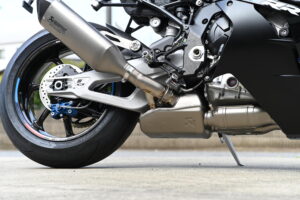
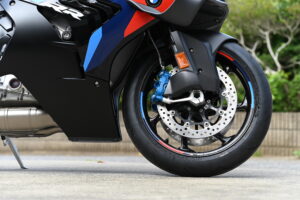
SGF’s Stance: Lowering and Rebuilds with the Same Philosophy
As a suspension specialist, I view lowering, rebuilds, and setup with the exact same philosophy. I never think “just lower it” or “just make it stiff for sport.” My goal is to align front/rear pitch with the rider’s physique and usage, ensure proper tire contact, and thereby hand over a margin of safety to the electronic controls.
For lowering (whether using our LGN or LTD solutions), the goal is not just “easier to ride,” but to raise the quality of the ride. For rebuilds, it is not just about stopping leaks. We aim to identify internal wear and aging, to restore it to as-new performance—and then refine it further.
Precisely because electronics have evolved so much, the fundamental character of the chassis is becoming more of a decisive factor than ever. No matter how expensive the IMU or computer, if the tire is hopping, the data the control system picks up will be noisy. I believe that organizing the world of a few centimeters between the tire and the road is, in the end, the most fundamental safety measure and the most effective form of tuning.
※Note on LGN / LTD: These are SGF’s proprietary lowering solutions. Unlike generic methods that often sacrifice handling for height, we employ a calculated tuning approach designed to harmonize the lowered position with chassis dynamics. We ensure the bike retains its natural handling and performance quality.
Meshing the “Magic” of Electronics with the “Truth” of Suspension
Whether you want to lower your bike, want to “make the current electronic suspension truly yours,” or want a simple naked bike to run smoothly. First, tell us a bit about your rider profile (your build, typical gear load, and how you ride). From there, we can draw a map together: “Is lowering better?”, “Is setup enough?”, or “When is the timing for a rebuild?”.
Note: Ride-height changes may affect local regulations and warranty terms. Please check with your dealer or point of purchase in advance.
Contact Information (Direct Contact Recommended)
We recommend contacting us directly via the following methods for detailed technical consultation.
-
Phone: +81-90-3316-5306
-
LINE: @llv7594i
-
Email: sgf@sgfacendo.com
-
Contact Form (Optional): https://sgfacendo.com/contact/
We await consultations from those who wish to properly mesh the magic of electronic control with the truth of suspension.