
Full-Hard Lock” and ECU-Related Issues After Aftermarket Dampers/Cancelers: Case Notes (Ferrari 575M / BMW EDC, etc.)
Report: “Full-Hard Lock” & ECU-Related Issues After Aftermarket Dampers / Cancelers
Case Notes (Ferrari 575M / BMW EDC and related systems)
1) Summary (Conclusion)
If an electronically controlled damper remains stuck in a stiff setting or a warning does not clear after overhaul (O/H), the root cause is not necessarily a damper fault. It may be related to the vehicle side—including the ECU, wiring, prior modification history, cancelers (dummy resistors / cancellation modules), and/or coding.
Overseas discussions and user reports suggest risks such as heat generation, malfunction, and failsafe full-hard lock when cancelers are involved.
This note is a short technical brief for workshops, intended to clarify troubleshooting assumptions and responsibility boundaries.
2) SGF Inspection Scope (Facts)
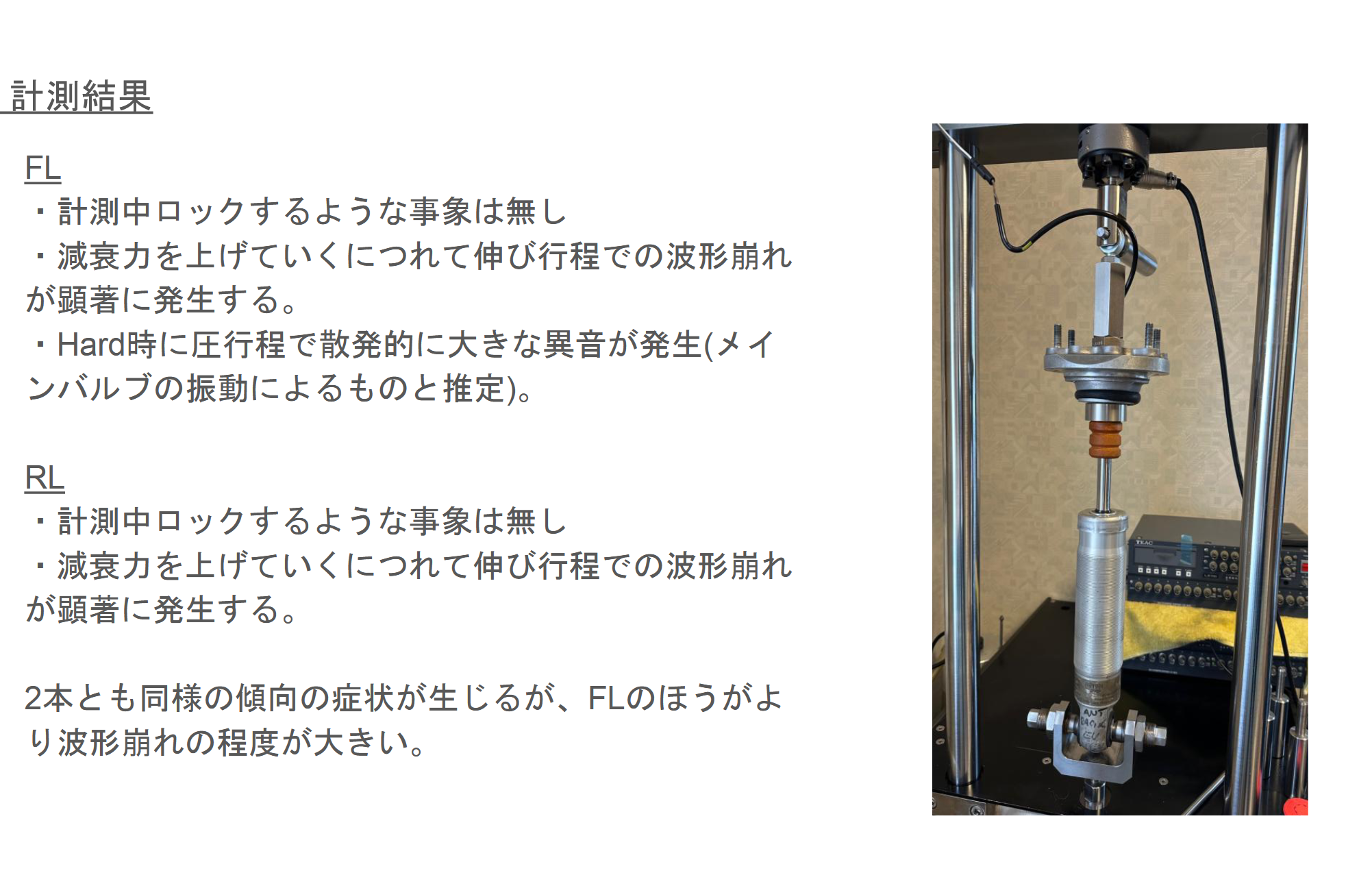
At SGF, electronically controlled dampers are inspected off the vehicle (bench test) prior to shipment. We confirm the following:
-
Electrical actuation (current / power test): performed on all units
We verify that the solenoid valve responds and actuates as expected. -
Damping delta check (damper tester): performed as needed
We verify that damping changes (a measurable difference) when control is switched ON/OFF or when command input changes.
“As needed” includes: first-time cases, symptom reproduction cases, or upon request by the customer workshop.
Notes
-
In this document, “bench test” refers to electrical actuation confirmation (power/solenoid response) and, when applicable, damping delta confirmation.
-
Vehicle-side diagnosis or guarantee (ECU / wiring / coding) is out of scope.
-
Detailed specifications and numeric thresholds of the test equipment are not covered here.
3) Why “Vehicle-Level Issues” Still Get Reported
A common field assumption is: “If the damper is OK on the bench, it must be OK on the vehicle.”
However, electronically controlled damping systems monitor circuit states and responses at the vehicle level, so installation may expose vehicle-side bottlenecks such as:
-
The ECU cannot detect the expected response (circuit state, resistance range, return signal, communication)
-
A canceler is used primarily to “turn off the warning,” while control/diagnostic state changes elsewhere
-
Re-installation or rework is repeated without improvement, requiring vehicle-side troubleshooting
Key point: bench-level integrity and vehicle-level integrity can be independent.
4) Highlights from Overseas Reports (Ferrari 575M focus, BMW supplementary)
Ferrari 575M (ZF Sachs-type systems)
-
Reports suggest that after a fault is detected and a warning is triggered, the system may enter a failsafe mode, effectively locking dampers into a full-hard setting.
-
There are reports where, after installing aftermarket dampers with cancelers, returning to OE dampers does not immediately restore normal control, and reset/restore may be difficult.
-
Discussions include possibilities such as ECU fault-flag retention behavior and potential effects of canceler load on vehicle-side circuitry.
(All statements here reflect “reports and discussions,” not SGF’s definitive determination.)
BMW (EDC / CDC systems)
-
EDC-related faults have been reported to affect not only warning messages but also integrated vehicle control, potentially restricting certain driving modes.
-
Cancelers are not always a complete solution; issues such as heat, failure, and unstable error suppression have been reported.
-
Conversely, there are cases where vehicle-side disabling (coding) has been used to avoid warnings/limitations (assuming work is performed by experienced specialists).
Note: Similar discussions exist for other OEM electronic damping systems (Mercedes, Porsche, Audi, etc.). This note limits itself to general positioning rather than exhaustive coverage.
5) Pre-Work Checklist (For Workshops)
Before sending electronically controlled dampers for service, please confirm and share:
-
Any prior history of aftermarket dampers / cancelers / coding (mandatory disclosure)
-
Presence of warning indicators and any readable fault history (within available diagnostic capability)
-
Who is responsible for vehicle-side integrity checks (ECU / wiring / connectors): the customer workshop or a partner
-
Whether the workflow assumes vehicle-side diagnosis first if an issue appears after O/H
-
Shared understanding that ECU-side actions (diagnostic reset, replacement, etc.) may be required in some cases (as a possibility, not a certainty)
Recommendation: Because countermeasures vary by vehicle, determine the root cause via vehicle-side diagnosis (ECU / wiring / fault history) before selecting a remedy.
6) Conclusion (Responsibility Boundary)
SGF performs bench inspection of electronically controlled dampers, including electrical actuation confirmation on all units prior to shipment.
Damping delta confirmation is performed as needed, depending on case context and symptom requirements.
Vehicle-side failsafe behavior or control loss related to ECU, wiring, or prior modification history (aftermarket dampers / cancelers / coding) may occur independently of damper O/H, as suggested in overseas reports.
Therefore, prior disclosure and a vehicle-side diagnostic-based troubleshooting process are essential.
Key Takeaways (Internal Summary)
-
“Stuck stiff / warning won’t clear” is not limited to damper defects; vehicle-side factors (ECU / wiring / modification history) may be responsible.
-
Cancelers may suppress warnings but are discussed alongside risks such as full-hard lock, heat, and instability.
-
SGF bench-tests units prior to shipment; vehicle-side failsafe/control issues are separate, so disclosure and vehicle-side troubleshooting are required.
References (Accessed: 2026-02-02)
